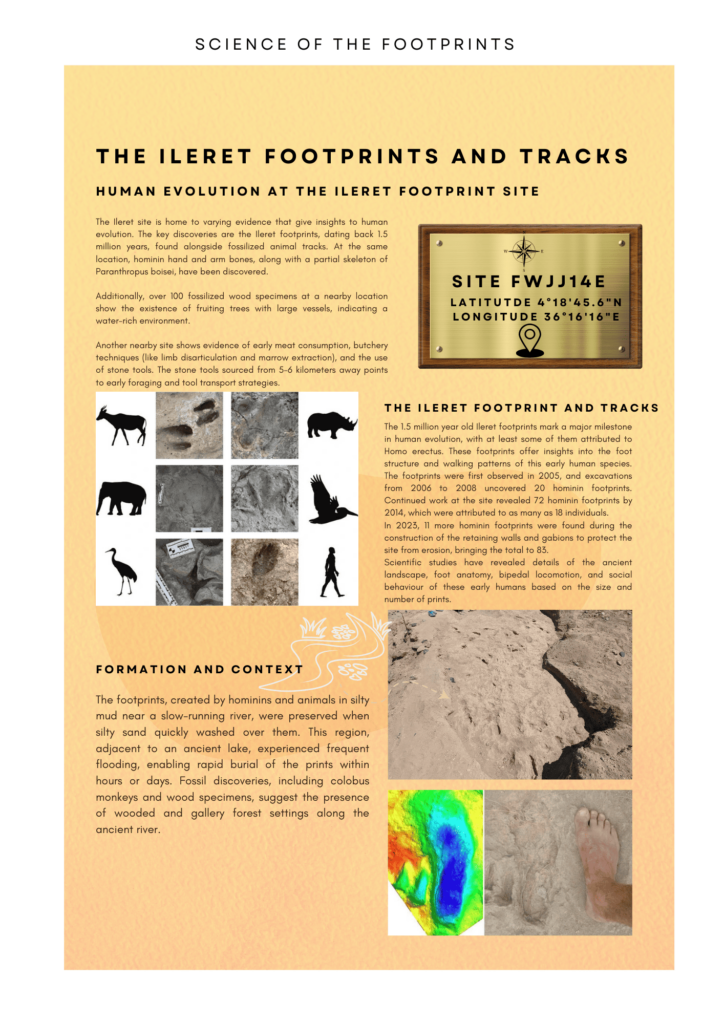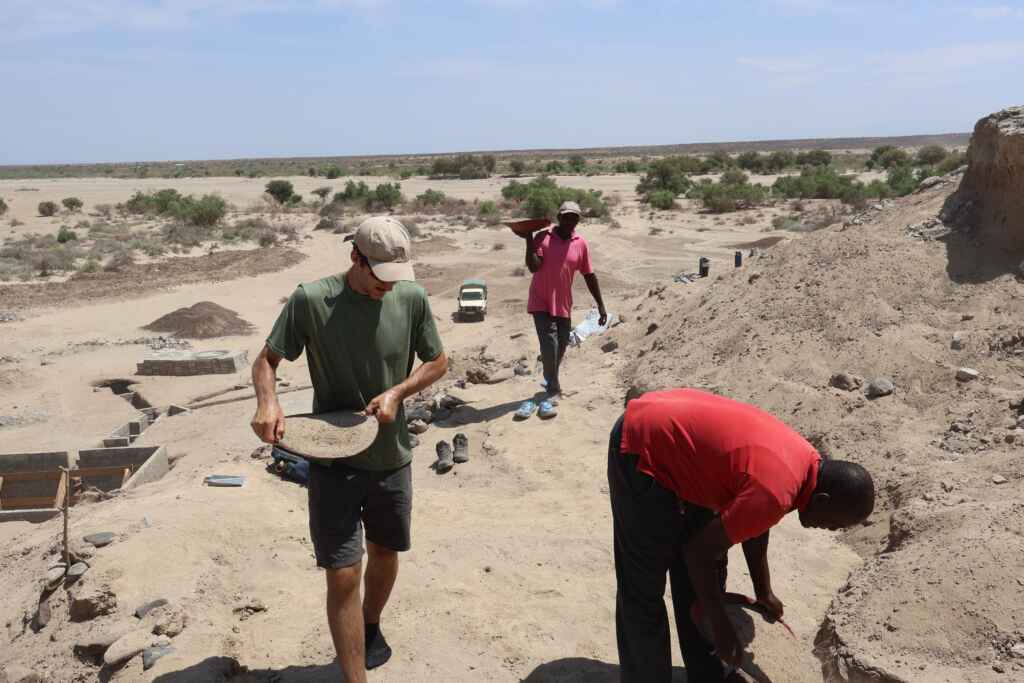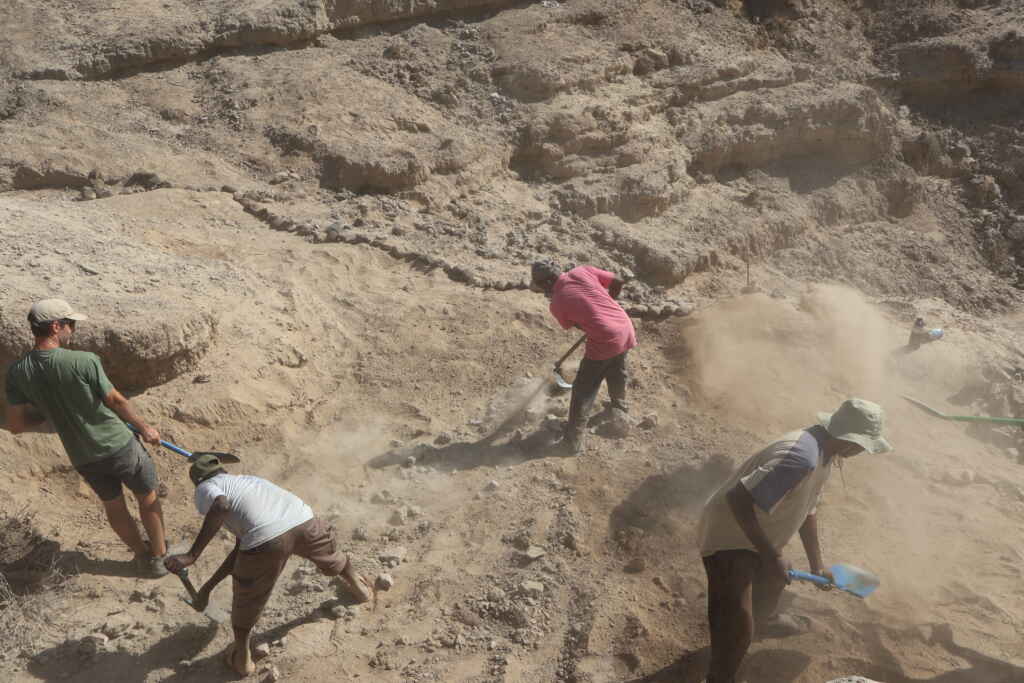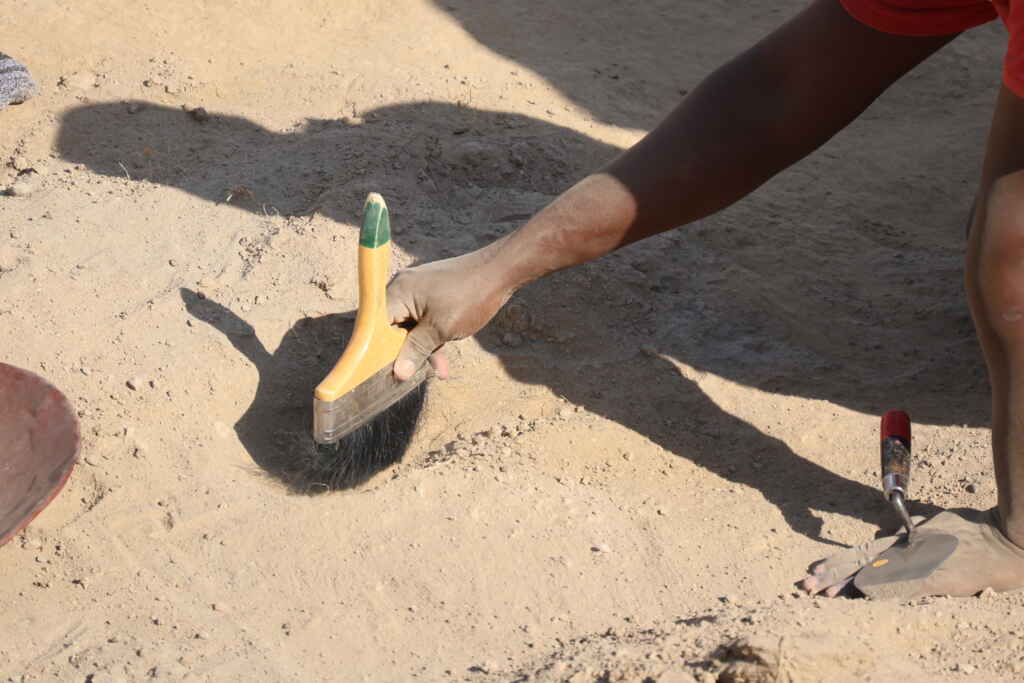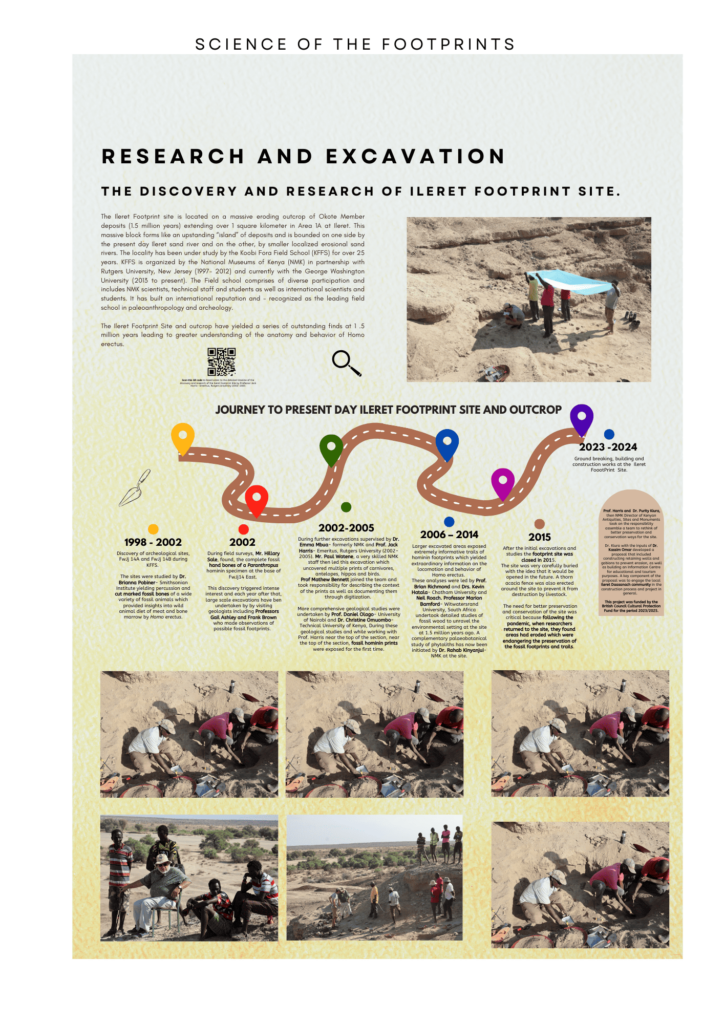


The Ileret Footprint site is located on a massive eroding outcrop of Okote Member deposits (1.5 million years) extending over 1 square kilometer in Area 1A at Ileret. This massive block forms like an upstanding “island” of deposits and is bounded on one side by the present day Ileret sand river and on the other, by smaller localized erosional sand rivers (see figure). The locality has been under study by the Koobi Fora Field School (KFFS) for over 25 years. KFFS is organized by the National Museums of Kenya (NMK) in partnership with Rutgers University, New Jersey (1997- 2012) and currently with the George Washington University (2013 to present). The Field school comprises of diverse participation and includes NMK scientists, technical staff and students as well as international scientists and students. It has built an international reputation and – recognized as the leading field school in paleoanthropology and archeology.
The Ileret Footprint Site and outcrop have yielded a series of outstanding finds at 1 .5 million years leading to greater understanding of the anatomy and behavior of Homo erectus. In the beginning of the study, KFFS camped every year along the banks of the Ileret River within walking distance of the outcrop. During the 1998 – 2002 field seasons, the first of these discoveries and excavations were two very important archeological sites, FwJj 14A and FwJj 14B. These sites were studied by Dr. Brianna Pobiner- Smithsonian Institute. They yielded percussion and cut marked fossil bones of a wide variety of fossil animals which provided important insights into wild animal carcass acquisition and processing, and the diet of meat and bone marrow by Homo erectus.
In 2002 during field surveys, one of the skilled Dassanech staff member Mr. Hillary Sale, found at the base of the Footprint outcrop at the site of FwJj14 East, the complete fossil hand bones of a Paranthropus hominin specimen (see casts). This discovery triggered intense interest and each year after that, large scale excavations were undertaken and during the excavations of a geological section by visiting geologists of Professors Gail Ashley and Frank Brown observations of possible fossil footprints were made.
This led further excavations with those at the lower footprint horizon being supervised by Dr. Emma Mbua- formerly NMK and Prof. Jack Harris- Emeritus, Rutgers University (2002-2005). Mr. Paul Watene, a very skilled NMK staff then led this excavation which uncovered multiple prints of carnivores, antelopes, hippos and birds. Some of the prints were of wading birds that suggested that the riverine fossil footprints were close to the margins of an ancient lake. Prof Mathew Bennett joined the team and took responsibility for describing the context of the prints as well as documenting them through digitization.
In addition, more comprehensive geological studies were undertaken by Prof. Daniel Olago- University of Nairobi and Dr. Christine Omuombo- Technical University of Kenya, who was then Prof. Olago’s graduate student. This included exposing and description of the 9 meters’ thick profile of the overall outcrop. During these geological studies and while working with Prof. Harris near the top of the section, a layer for the first time containing fossil hominin prints were exposed.
In the years that followed, larger excavated areas in this upper layer exposed extremely informative trails or trackways of hominin footprints. More detailed studies of the footprints yielded extraordinary information on the locomotion and behavior of Homo erectus. These analyses were led by Prof. Brian Richmond and Drs. Kevin Hatala- Chatham University and Neil Roach- formerly at Harvard University who were then his graduate students at George Washington University. Prof. Richmond and his colleague Dr. Roshna Wunderlich- James Madison University and their students studied the locomotor capabilities of modern day Dassenach at Ileret which have been invaluable for comparative purposes. Professor Marion Bamford- Witwatersrand University, South Africa undertook detailed studies of fossil wood to unravel the environmental setting at the site at 1.5 million years ago. A complementary palaeobotanical study of phytoliths has now been initiated by Dr. Rahab Kinyanjui- NMK at the site.
These initial excavations and studies at Ileret Footprint Site were closed in 2015. The site was very carefully buried with the idea that it would be opened in the future. A thorn acacia fence was also erected around the site to prevent it from destruction by livestock. The need for better preservation and conservation of the site was critical because following the pandemic, when researchers returned to the site, they found areas had eroded which were endangering the preservation of the fossil footprints and trails.
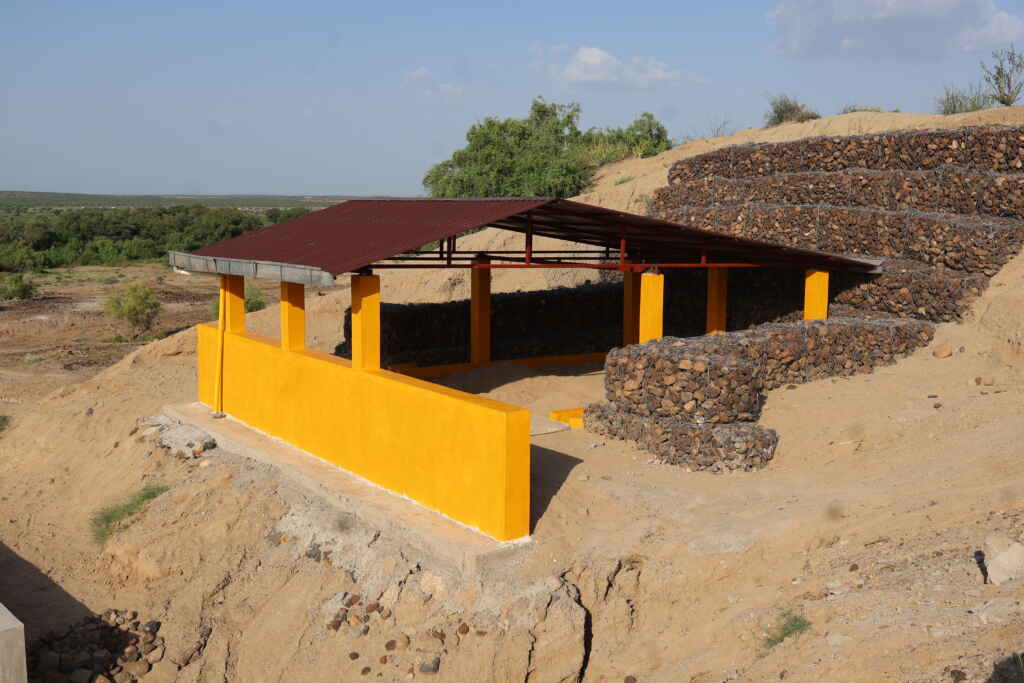
Through discussions with Prof. Harris, Dr. Purity Kiura, then NMK Director of Kenyan Antiquities, Sites and Monuments took on the responsibility of reorganizing former museum and foreign researchers and staff to rethink of better preservation and conservation ways for the site. In very innovative ways, Dr. Kiura with the inputs of Dr. Kassim Omar (then NMK Chief Architect and Physical Planner) together with others, developed a comprehensive proposal that not only addressed the preservation of the site which included building huge retaining walls and gabions to prevent further erosion but also an Information Centre for educational and tourist purposes. A major aim of this proposal was to involve the local Ileret Dassenach community in the construction in all faucets and also to collect run off water at the site as a source of clean water for the community. The future conservation of the site, administration of the educational and tourist facility is now under the Dassenach community. The project was funded by the British Council Cultural Protection Fund for the period 2023/2025.
Other scientists who have been involved with research at the site include Drs David Braun- George Washington University, Emmanuel Ndiema & Rahab Kinyanjui- NMK, Jack Mcoy- formerly Rutgers University, Jonathan Reeves- George Washington University, David Green- Mid-West University, Brian Villmore-University of Nevada, Heather Dingwall- Havard University, Zachary Kuria- Technical University of Kenya, Professors. Kay Behrensmeyer- Smithsonian Institute, Stephen Merritt- The University of Alabama at Birmingham, Kelley Ostrofsky- Rocky Vista University, Andrew Du-Colorado State University.
Excavations, molding and casts were undertaken by Mr. Benjamin Sila, David Kipkebut, Hillary Sale, Mr. James Mwangi, Gabriel Muya assisted by local Dassanech members.
For this project, other collaborators have been involved and include Ms. Josephine Muthoni Thangwa- Heritage Practioner and trainer, Mr. Espera Donouvossi- Heritage Professional at ICCROM, Mr. Calvin Amenya- Site Supervisor and Assistant Architect, Mr. Michael Muteti (Site Structural Engineer), Ms. Beryl Sindi (Site Quantity Surveyor), Mr. Andrew Nyameto- Local Site Assistant and foreman. The project has also worked closely with the local community particularly with the construction of the conservation installations through the guidance of Community Project Implementation Committee (CPIC) under the chairmanship of Mr. Nyemeto.
The NMK exhibition development team- Ms. Suzanne Wanjaria (Lead exhibition developer & designer), Ms. Betty Karanja, Ms. Lydia Kitungulu, Ms. Vivian Kinoti, Ms. Grace Gude, Mr. Albert Otieno, Mr. Gabriel Muya, Mr. Maina Karenju.